
Low Vision Aids & Prosthetics
Overview
Low Vision Aids and prosthetics are designed to help individuals with significant vision impairment or loss to improve their quality of life and functionality.
Low vision aids are devices and tools used to enhance remaining vision and help people with visual impairments perform daily tasks. They are not intended to restore vision but to maximise the use of existing vision.
Low Vision Aids And Prosthetics
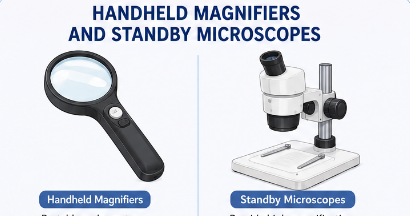
Handheld Magnifiers
Stand Magnifiers
Magnifiers that rest on a table or desk, often equipped with built-in lighting for easier use
Electronic Magnifiers
Monocular Telescopes
Portable magnification devices for viewing distant objects, used with one eye

Binocular Telescopes
Closed-Circuit Television (CCTV)
Systems that use a camera to project enlarged images onto a screen, allowing for adjustable magnification
Text-to-Speech Devices
who have difficulty reading
Electronic Glasses
Wearable devices with cameras and displays that assist with reading, face recognition, and more

Large Print Materials
Braille Tools
Braille displays and notetakers that convert text to Braille for reading and writing

Prosthetics
Artificial Retinal
Retinal Implants :Devices implanted in the eye to stimulate the retina, aiding individuals with retinal degenerative diseases like retinitis pigmentosa.
Argus II Retinal Prosthesis System:A specific retinal implant that provides partial vision to individuals with severe retinitis pigmentosa.

Bionic Eyes
Devices implanted in the eye or brain to provide visual information, potentially restoring some degree of vision.
Orion Visual Cortical Prosthesis System
A system that bypasses the eye and directly stimulates the visual cortex, designed for those with damage to the optic nerve or eye.

External Vision Prosthetics
Devices that capture visual information and convert it into auditory or tactile feedback.
eSight Eyewear
Glasses equipped with a camera and digital display that enhance and project images to the wearer’s eyes
